CYBERDYNE VERSION 2
From diesel wrenching to distributed infrastructure. A dual-system compute platform built from scratch inside a single case. No guide. No tutorial. No one else's ideas.
Where This Came From
This didn't start as "I want a cool PC."
It started as wanting control. Wanting automation. Wanting leverage. Wanting income from idle hardware. Wanting zero dependence on anyone.
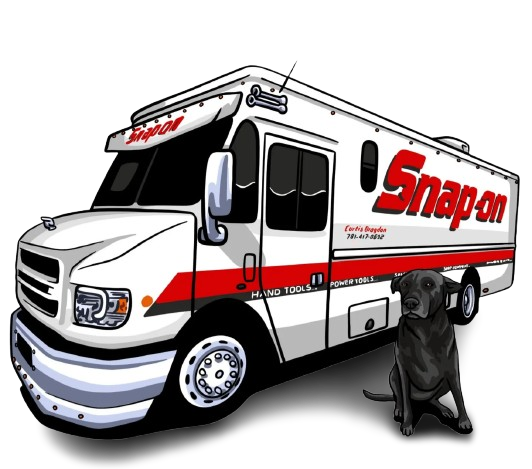
I'm a diesel tech turned Snap-on franchise owner in Lynn, Massachusetts. I already think in systems — trucks, routes, margins, uptime. The PC just became the digital version of that.
"I don't build toys. I build platforms."
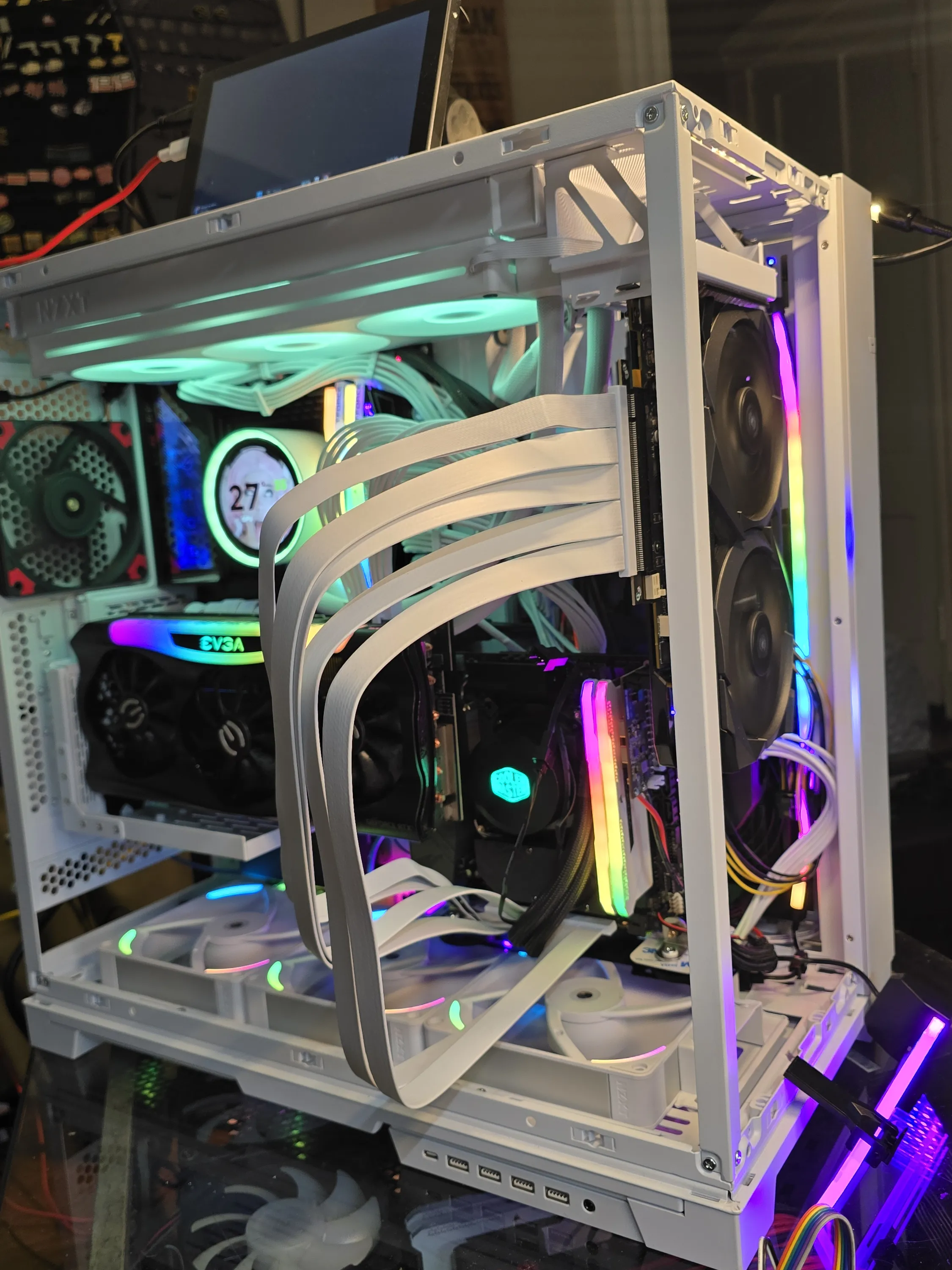
Sure, dual-system cases exist. Companies like Cougar, Phanteks, and Thermaltake sell cases designed for two motherboards. Those follow instructions. I took a case designed for one system and put two entire computers inside it — held together with magnets, VHB tape, and audacity. There was no manual for any of this.
How It Escalated
One Board, One GPU, Push It Hard
Started with a Z790 Hero and a single GPU. Stress tested it. Learned the hardware. Pushed it to its limits. Found the limits weren't enough.
Second Board In The Same Case
Mounted a Mini-ITX B760i on magnetic standoffs and VHB tape. Built a custom power solution with a Pico DC-ATX converter. Two independent computers, one chassis.
Triple GPU + PiKVM + Internal Network
Three GPUs driving 7+ monitors. PiKVM for remote BIOS control. Dual-port Ethernet NIC creating a direct backbone between both systems. ICS for internet sharing. Everything accessible remotely.
Distributed Compute Network
Added 10 Linux phones running K3s Kubernetes. Ethernet over USB-C. Tailscale mesh. Remote wake, remote shutdown, SSH orchestration. Built a personal edge compute grid.
Automation & Business Integration
PowerShell automation for everything. Custom scripts, batch execution, timestamped logs. The rig became the backbone for Snap-on operations, website deployment, AI experiments, and monetization platforms.
Dual Systems, One Case
CYBERDYNE Primary
ASUS ROG Maximus Z790 Hero • ATX • LGA1700
CYBERDYNE Secondary
Gigabyte B760I AORUS Pro DDR4 • Mini-ITX • LGA1700
The PSU Hack
Both systems run off a single 1300W PSU. The main board connects normally. The ITX board is powered by a Pico DC-ATX converter that receives 12V through a custom adapter chain. No second PSU. No sync board. No external power brick. Not standard. Not normal.
This Is Not A Gaming PC
Compute Lab
Mining tests, AI inference, automation scripts, remote orchestration, SSH clusters, WOL/Moonlight/PiKVM control. The question was always: "Can I make money with this thing when it's idle?"
Distributed Network
10 Linux phones on Ethernet over USB-C. Tailscale mesh. K3s Kubernetes. Node shutdown scripts. Remote power control. A personal edge compute grid.
Control Hub
Snap-on ops machine. Monitoring dashboards. Multi-display command center. PowerShell automation with audit mode, fix mode, timestamped logs, batch execution.
Business Platform
Website deployment. Link hub management. Traffic control. eBay card shop automation. AI workloads. Every idle cycle is a missed opportunity.
Remote Access
PiKVM v4 Mini for BIOS-level control. Tailscale mesh across all devices. Moonlight streaming. Steam Deck WOL integration. Accessible from anywhere, always.
Content Engine
7+ monitors. 15+ display outputs. SignalRGB coordinated lighting. AIDA64 sensor panel. Eyoyo internal display. Built to create, not just consume.
The Stack
PiKVM v4 Mini
Remote BIOS-level access. Full keyboard, mouse, display capture over IP. Connected to the Z790 Hero. Boot, configure, troubleshoot — from anywhere.
Dual-Port Ethernet NIC
PCIe card in Slot 1 creates a direct internal backbone. Port 1 → PiKVM. Port 2 → B760i. ICS for internet sharing. No external switch needed.
Multi-Display Array
7+ monitors. Two Alienware AW2725DM on the 3070 Ti. Remaining screens on the second GPU. ITX board gets its own dedicated display. 15+ outputs available.
Tailscale Mesh
Encrypted mesh VPN connecting both boards, Steam Deck, phone cluster nodes. Accessible from anywhere. No port forwarding.
18 Fans + RGB Stack
SignalRGB + L-Connect + FanControl. 3 RGB hubs (1 internal, 2 external runs). Custom 12V→6V buck-converted mini fans. Aggressive airflow tuning.
Monitoring Suite
AIDA64 sensor panel. Multi-channel temp sensors. Eyoyo internal display. FanControl managing all 18 PWM curves. Armoury Crate. Nothing runs unmonitored.
At A Glance
Lian Li O11 Dynamic XL
Designed for one system. Now housing two motherboards, three GPUs, two AIOs, a PiKVM, a dual-port Ethernet NIC, 18 fans, RGB hubs, sensor arrays, and an internal display. The dual-chamber design provides PSU space in the rear while the main chamber accommodates a layout no case manufacturer ever intended.
The Bigger Picture
This whole system is a way of scaling beyond physical labor.
From diesel wrenching to tool truck owner to automated infrastructure operator. That's the real evolution. CYBERDYNE isn't about RGB or benchmarks. It's about autonomy, capability, optionality, control, and scalability.
It can run scripts 24/7. Host AI models. Monitor live platforms. Automate business operations. Deploy websites. Manage distributed nodes. Control machines remotely. All from one case that was never designed to do any of it.
I didn't build a PC. I built infrastructure.